del Syke – “a dweller by the stream”?
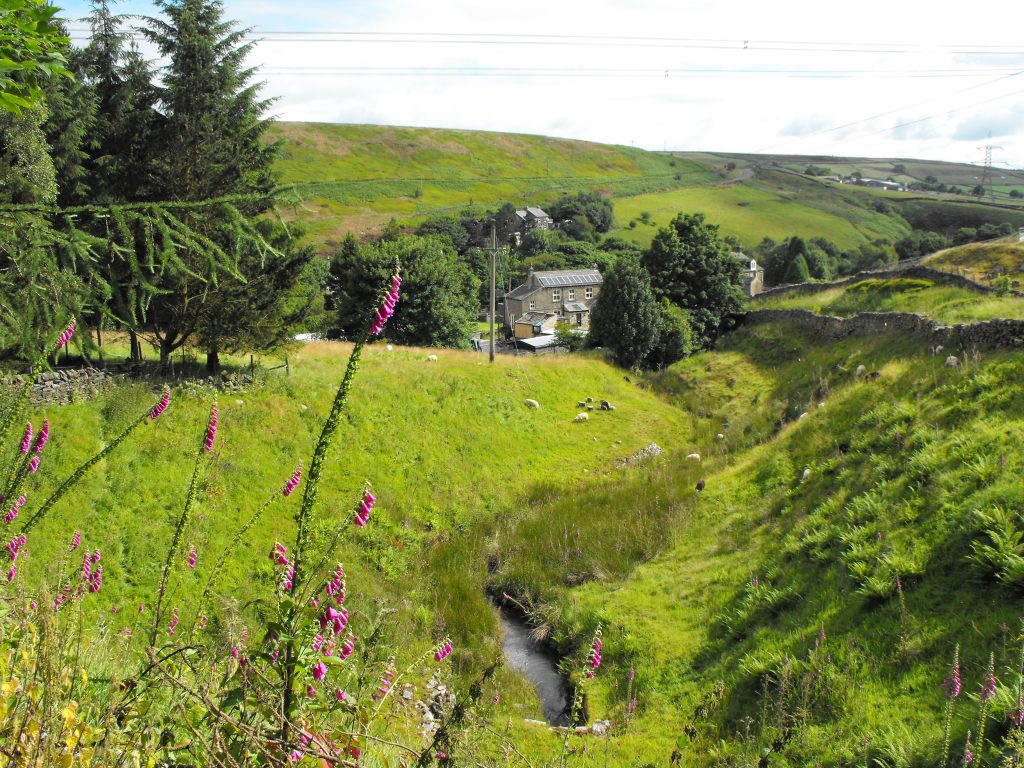
“as far as the main sike; and where there is no sike, as far as the middle of the marsh” (Holme Cultram Abbey boundary 1179)
syke, sik, sik, syk, syc
Middle English sike, pronounced with a hard “k”, the northern form of Old English sic (pronounced sitch)
“A gutter or ditch; a small stream that frequently dries up in summer” (Scotland)1
“Siketum; something less than a beck or stream. The northern word is exact, a Sike (Durham)“2
“Sykes were generally wide, shallow, slow-flowing streams with only a slight drop in altitude along their length, and so proved ideal watering places for animals. The syke would frequently form the boundary between furlongs in the common fields ….. the syke was usually fed from a spring … (and) .. promoted a lush growth of grass along its banks, which was highly prized for grazing and as a hay crop”3. (F&M)
“Unploughed area in an open field, usually low lying and damp and unsuitable for ploughing, where grass grows”4
“An interesting local surname, originally a place name, seems to vary in meaning according to the district; in the north its commonest meaning is a mountain stream, a small stream, a large gutter; in the west country it signifies a ditch; a trench with water, a marshy bottom into which water flows; in the Midlands a wide strip of uncultivated land serving as a roadway (a relic of the three field system of cultivation)”5
Sykes is classed as a “topographic” surname derived from an old English term for a small stream or water-course. Early spellings variants include syk, sic, and sike, but all refer to the same type of landscape feature. This term was widely used in medieval documents across the country, particularly Yorkshire, and a similar form can be found in Germanic speaking parts of Europe.
The meaning of sykes can be interpreted in several ways, some examples are quoted in the left-hand column, which are discussed below. In this text, other than when quoting original sources, landscape features are referred to as “Sike” and surnames as “Sykes”.
Sike has largely been replaced by dyke in both standard English and local dialects but modern Ordnance Survey maps still carry many Sike place-names, particularly in the northern uplands. Large scale maps of our National Parks show abundant small “Sike” streams in upland England, principally in the Pennines and North York Moors. They are common in the Forest of Bowland (straddling Lancashire and Yorkshire), the Yorkshire Dales and South Pennines west of Halifax. Fewer examples are found in the Lake District to the north and the Peak District to the south. Many of these Sike names on OS maps were probably first recorded by early surveyors who collected oral evidence as well as physical and documentary evidence when compiling the early editions (nineteenth century).
Sike names are less commonly found in lowland landscapes. Although there are widespread examples these do not occur in clusters and tend to be more dispersed than in the uplands. Their features are more consistent with the open field descriptions in notes 3 & 4 opposite, their locations will be discussed further in the section on “Syke Houses“.
Almost all the upland sike features have common features. They are not just random streams, they are the very smallest streams arising on or near the watershed, usually above 300 metres and often in boggy ground, frequently called “slacks”, “moss” or “rushy”. These combine the kind of conditions described at Holm Cultram and Durham (Middleton) and fit Dyson’s understanding of the northern version of sike (note 5). The upland sike is a stream of the highest, most inhospitable parts. It tends to fall quickly, but as it gathers breadth and depth downstream its name invariably changes to become a “Ghyll” or “Beck”.
Permanent medieval settlements in these areas are inevitably in the valley bottoms below the sike, i.e. the hamlet of Sykes in the Trough of Bowland. However in many such areas there is place-name evidence of temporary shelters, shielings or “booths” used seasonally by the peasants and their families who were employed by large estates to manage these upland “wastes” as hunting forests or vaccaries (cattle ranches). Cattle, and less frequently sheep, grazed the wastes where arable crops could not flourish but where they could co-exist with the deer and wild boar that provided hunting for the landowners. This may be a clue to the identity of those first Sykes – people who spent half their year living rough in the desolate, wet wastes. If so, it is possible the name was originally a derogative nickname, like “hillbilly” rather than just “a dweller by the stream”. On the positive side, it’s also possible it signified a hardy person with livestock handling skills.