Most authorities accept Yorkshire as the source location of the Sykes name. This section provides an overview of the early dispersion pattern within the county by identifying all known Sykes locations and arranging them into a handful of clusters where there appears to be some relationship between the individual settlements. We can define a cluster in several ways; (i) geographically, where a number of settlements are located adjacent or physically close to each other (ii) dispersed locations connected through a common manorial lordship (iii) economically connected communities sharing markets, resources or skills. All three factors may overlap to some degree and these connections will be examined in the subsequent profiles. The initial focus is on settlements within West Yorkshire, then subsequently looking at outliers in the East Riding and adjacent counties.
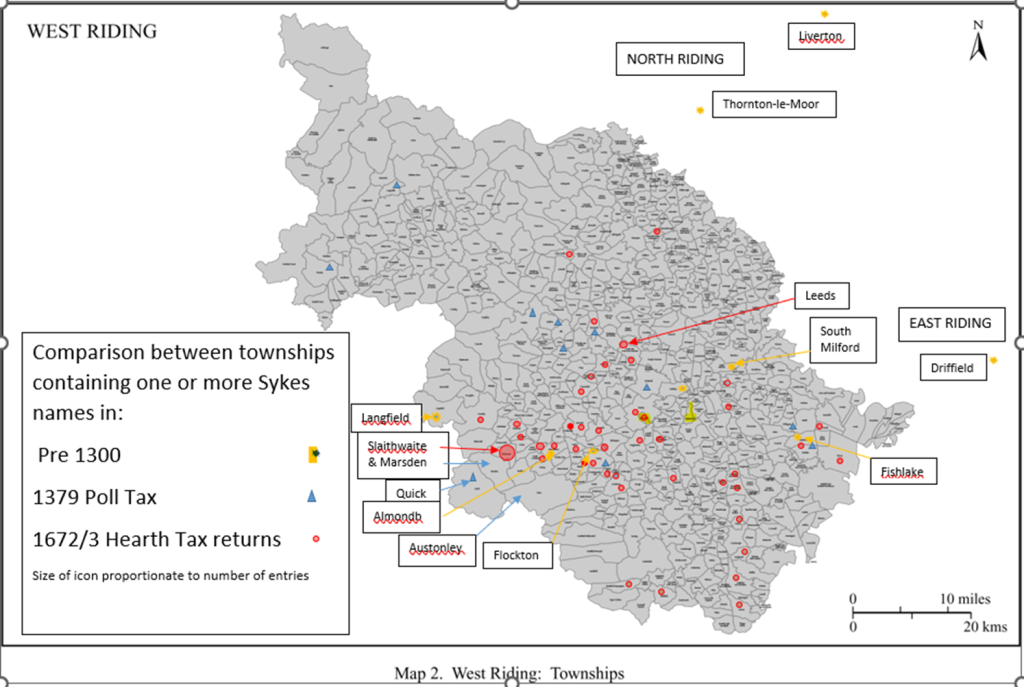
9a: Distribution Map of Sykes Settlements at 3 intervals pre-1300, 1379 & 1672/3
Map 9a above overlays Sykes household distribution across the West Riding of Yorkshire at three critical time intervals (i) pre-1300, the earliest written records (ii) 1379, the “Poll Tax” which notionally recorded all households village by village (iii) 1672, the Hearth Tax which recorded all households village by village. The limitations of each of these sets of records are discussed in their respective chapters.
The overlays above clearly show a dominant cluster in mid-West Yorkshire, basically following the Colne and Holme Valleys and almost entirely within the ancient Wapentake of Agbrigg. Today this area is almost co-terminus with the post-1974 metropolitan area of Kirklees. in 1672 it comprised almost half of all Sykes entries in Yorkshire. It also contains one-third of the known pre-1300 records, including both Slaithwaite and Flockton, the two main contenders as sole source of Sykes origins. This cluster is referred to in the profiles below as Agbrigg but will be broken down into some of its main constituent parts.
A second cluster can be seen in the south-east corner of Yorkshire, centred on Fishlake and adjacent townships. Evidence shows continuous Sykes occupation here from pre-1300 to 1672. Sykes records also occur from the fifteenth century in several townships eastwardof Fishlake along the Humber levels.
A third cluster is evident around Airedale and Leeds but displaying two distinct profiles, The upper Airedale element is dominated by fourteenth century records, but Sykes settlements around Leeds are rarely recorded pre-sixteenth century.
East of Leeds lies the ancient kingdom of Elmet. Sykes are recorded in several dispersed settlements here from pre-1300 to 1672. This fourth cluster is located broadly in Lower Airedale mid-way between the Airedale Cluster and Fishlake. Together all three clusters trace a linear route along the line of the River Aire.
The fifth cluster is another linear arrangement stretching north-south down the ancient arable landscape on the narrow outcrop of magnesium limestone stretching south from Pontefract to the Nottinghamshire border. None of the Sykes settlements here are recorded pre-fourteenth century. Much of this area formed part of the ancient region of Morthen, still recorded in place names such as Laughton-en-le-Morthern.
The final sixth cluster lies in the East Riding and may be considered as containing two separate communities of interest. The first sub-cluster may be a continuation of the Fishlake cluster, stretching eastwards along the north side of the Humber towards the east coast. It includes places such as Snaith and Cowick where the earliest parish registers record already well established Sykes families. A second group north of the Humber may be either a separate cluster or related group spread across a much larger area than any of the earlier clusters. Most locations are semi-urban amongst the medieval market towns of Beverley, Market Weighton and Driffield. The port of Hull could have related to either sub-group, by the earliest parish registers there were established Sykes families baptising in two discrete churches within Hull.
Beyond Yorkshire’s boundaries there are small but significant Sykes settlements recorded in Nottinghamshire, Derbyshire, Lancashire and to a lesser extent, Lincolnshire. In all these cases there are discernible links with a Yorkshire interest, principally the manorial landlord, which strongly suggest a Yorkshire origin for these outliers.
These clusters will be explored in greater detail in the following sections, hopefully the cluster pattern will provide some context. Each cluster should not necessarily be seen as an isolated island, but as communities of interest who almost certainly inter-married, shared properties and economic activity.
The remainder of this page is still under construction
Airedale
Elmet
Flockton
Holme
East Riding
Colne